Platforms › RMP
Experimental platform · RMP
Rapid Manufacturing
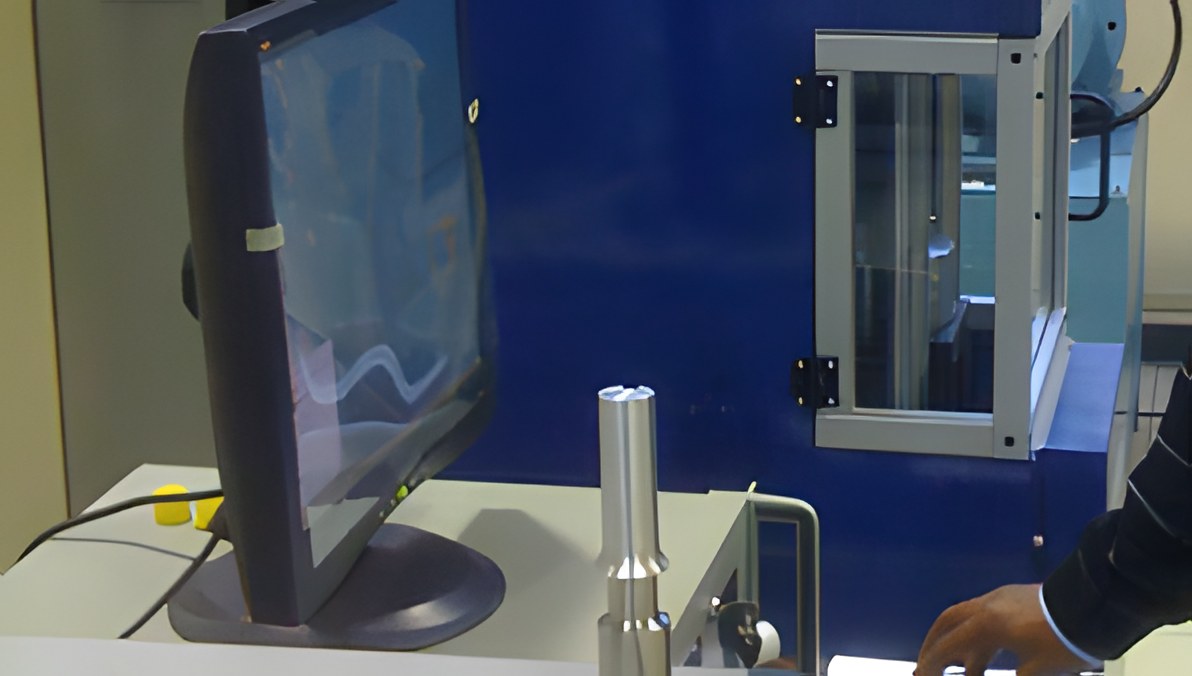
The RMP platform brings together several manufacturing processes: additive manufacturing, machining, forming, welding and bioprinting. It covers the design, manufacturing and inspection of parts, for industrial applications as well as for the medical field.
Processes
Additive manufacturing, machining, forming, welding, bioprinting
Sectors
Aeronautics, space, shipbuilding, automotive, rail, medical
See the manufacturing processes ↓
Key strengths
Biofabrication
3D printing of living tissue, with ITUN at Nantes University Hospital, IHU CESTI and the RMES team
Large hybrid parts
High-capacity robot (500 kg at 3 m): wire (WAM), powder (LMD), machining and polishing
Micron-scale work
Laser powder bed additive manufacturing: fine parts with controlled surface finish
Open numerical control
Open CN: user-defined algorithms, manufacturing modifiable in real time
Overview
The platform’s common thread is the control of trajectories in space, whether to deposit material, machine it or form it. The platform also contributes to the Additive Manufacturing work package of the Joint Laboratory of Marine Technology.
The platform’s facilities make it possible to design and simulate processes, manufacture parts from the micro scale to large dimensions, finish them and inspect them.
Manufacturing processes
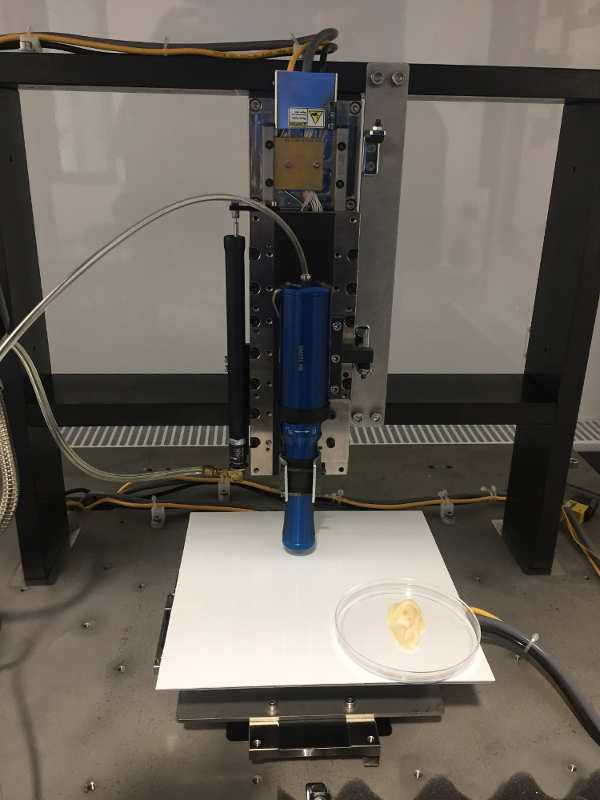
Biofabrication
Bioprinting consists of printing living tissue using 3D printing approaches. The work is carried out in close collaboration with the team of Prof. Gilles Blancho, director of ITUN (Institute of Transplantation, Urology and Nephrology) at Nantes University Hospital and of IHU CESTI, as well as with the RMES team.
Engineering and biology come together to define the process parameters: needle diameter, pressure to apply and material viscosity. Both the material and the process are now mastered.
The long-term goal is to explore the field of organ grafting and transplantation: (re)building an organ or parts of an organ from the patient’s own stem cells, in order to avoid rejection. The next step is the vascularisation of the created material.
Laser powder bed additive manufacturing
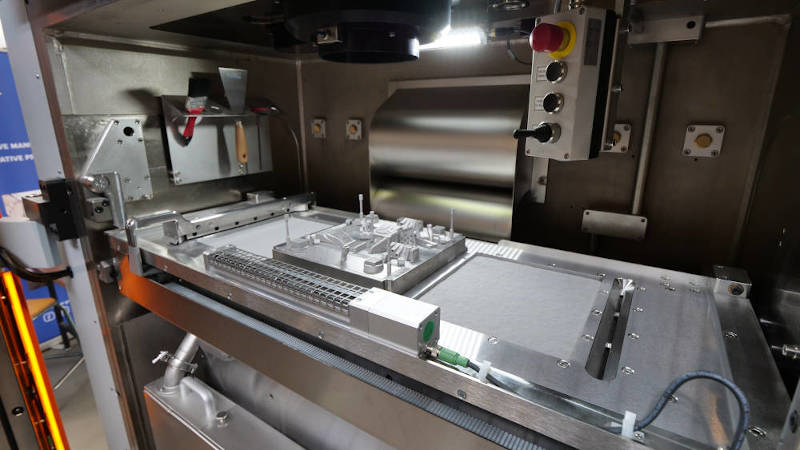
The laser powder bed additive manufacturing machine produces fine parts, both in dimensions and in surface finish, with micron-scale precision.
Powder is spread in a tray and then locally melted by a laser according to the geometry of the part; unmelted powder is recovered and reused.
The parts produced serve all sectors: aeronautics, space, shipbuilding, automotive, rail and medical.
Hybrid manufacturing of large parts
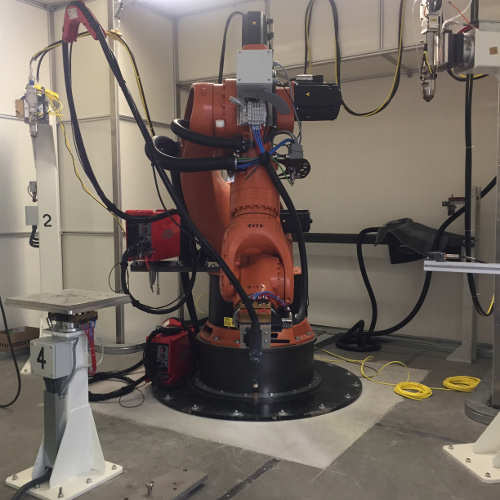
The robotic cell is equipped with a high-capacity robot able to carry 500 kg at 3 metres, for the hybrid manufacturing of large parts. It combines several processes: wire deposition (aluminium, titanium, steel…) melted by an electric arc (WAM) or powder deposition (LMD), with two heads depositing layers 2.5 mm or 4 mm thick.
The cell also performs part finishing (machining and polishing) when the as-built surface finish is insufficient.
Powder fusion and material gradients
This equipment makes it possible to mix powders during manufacturing to produce graded materials, combining powders chosen for their mechanical properties with others chosen for their tribological properties (the science of contact).
Precise, progressive mixing avoids the formation of a solidification front and promotes bonding between the two materials, making the part stronger.
Parallel kinematic machine
This five-axis prototype machine moves a mass of 150 kg, compared with several tonnes for other machines. It is used for machining, forming and welding.
It makes it possible to measure the forces and power required to machine a part, test and compare tools and assess their service life, in order to optimise the manufacturing strategy while meeting the specifications.
Medical applications
Additive manufacturing is also applied to the medical field. Following initial work on knee and hip prostheses, the platform is involved in several projects:
01
Hand prosthesis, with UTC and Saint-Antoine Hospital (Paris): metal phalanges made from titanium powder
02
Surgical guides for training and assisting surgeons
03
Repair of large bone defects combining stem cells and custom implants
New equipment is being acquired and installed as part of the State-Region Planning Contract (CPER).
Design, inspection and control
Calculation and simulation
Design and calculation in the following fields:
- Mechanics
- Fluid mechanics (particle spraying)
- Biofabrication (material mixing)
Inspection and measurement
Part inspection facilities:
- Precision laser scanner (accurate to the micron) to digitise the “skin” of an existing part and inspect parts produced by additive manufacturing
- Scanning electron microscope (60,000× magnification) to study powder behaviour and the structure of manufactured parts
- 3D microscope to measure the surface topology of objects
Numerical controls
An open numerical control, “Open CN”, has been developed at Centrale Nantes: it lets users define the algorithmic part themselves and modify manufacturing in real time. For their incremental forming projects and tests, manufacturers can also choose between the NUM (French), FIDIA (Italian) and Siemens (German) numerical controls.