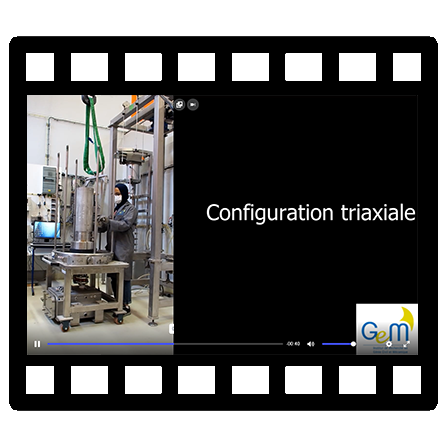
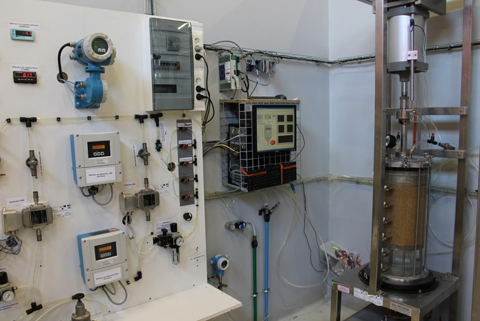
The Nantes Université Geomechanics Platform mainly consists of experimental prototypes, some of which are unique worldwide. These devices make it possible to characterise the hydromechanical behaviour of fine-grained and coarse-grained soils under complex hydromechanical loading. The prototypes are also used to study the effect of scalping on the mechanical behaviour of coarse-grained soils.
Numerical and experimental study of the effect of scalping on the behaviour of coarse-grained soils.
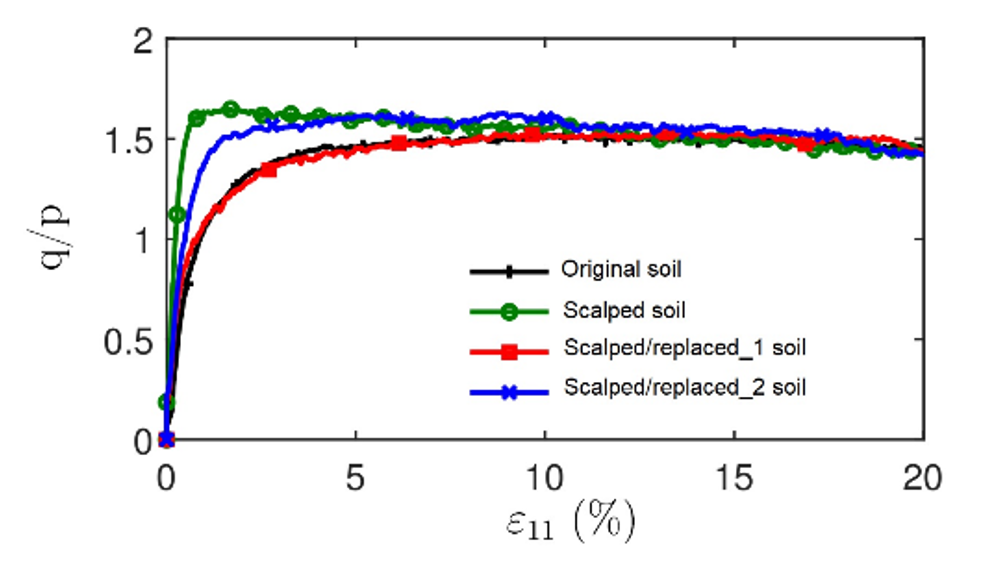
Comparison of triaxial test results on unscalped and scalped soils, using two substitution methods and three values of the ratio between maximum diameter and substituted grain diameter.
PhD thesis of Bikram Oli
Study of internal erosion in earthen hydraulic structures and of the behaviour of eroded soils under complex hydromechanical stress states.
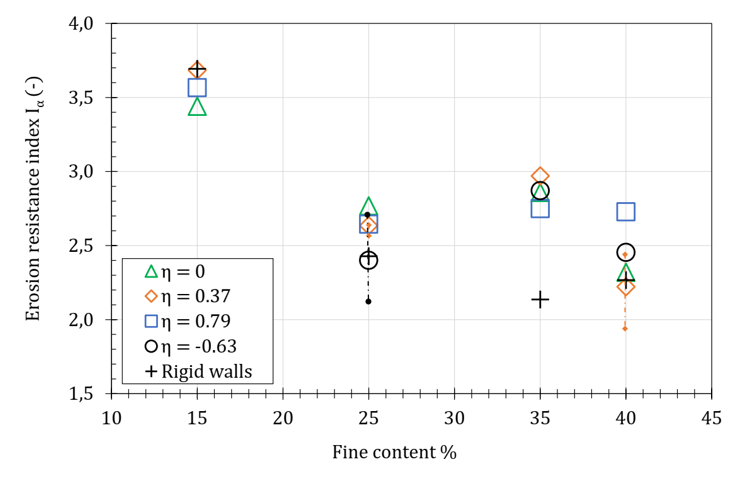
Evolution of the suffusion resistance index as a function of fines content and for different mechanical states.
PhD thesis of Mohamed El Shamieh and postdoctoral research of Bikram Oli (ANR PERSEE)
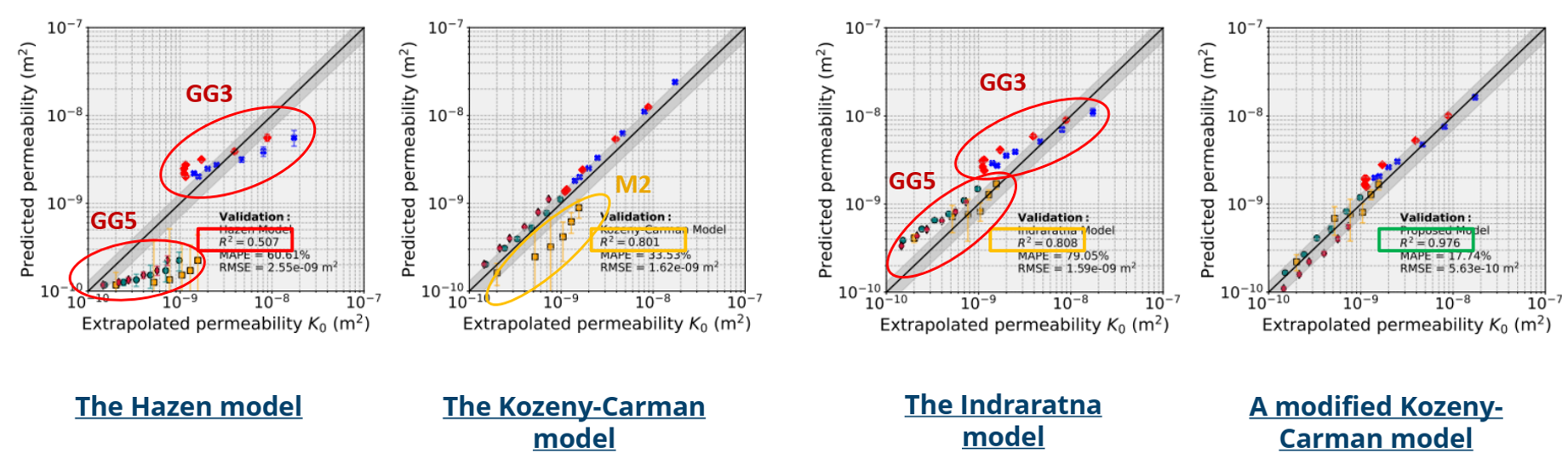
Experimental and numerical study of the evolution of the permeability of granular soils in the context of internal erosion by suffusion.
Comparison of the performance of three permeability models from the literature and the proposed model
Distinctive Experimental Facilities
Several devices have been developed to characterise the hydromechanical behaviour of different types of soil under various hydromechanical loading conditions.
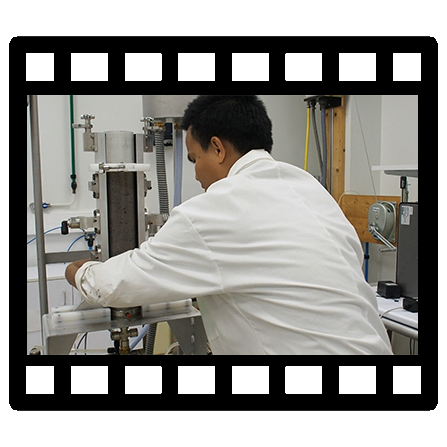
Developed in partnership with IMS RN, this erodimeter can test undisturbed samples under horizontal, oblique or downward vertical flow. An international patent application has been filed for this device.
Developed in partnership with EDF, this erodimeter characterises the hydromechanical behaviour of soil samples with a maximum grain diameter of 16 mm under complex hydraulic and mechanical loading.
Large-scale triaxial erodimeter
This erodimeter was developed in partnership with EDF to study suffusion and the mechanical behaviour of coarse-grained soils.
A large-scale permeameter for characterising the suffusion susceptibility of coarse-grained soils under oedometric conditions.
Fields of Application
Soil mechanics
Flow in porous media
Internal erosion
Earthen hydraulic structures
Flood protection
Levees, dams
Industrial Sectors Concerned
Earthen hydraulic structures (such as dams and levees) contribute to flood protection. They are also essential for inland navigation, hydroelectric power generation and nuclear reactor core cooling. Most of the instabilities these structures may undergo are caused by erosion phenomena. Among them, suffusion is one of the most complex, as it involves three coupled processes: detachment, transport and possible filtration of a fraction of the detached grains. This phenomenon therefore alters soil porosity, which can change its hydraulic properties (and hence the hydraulic loading itself) as well as its mechanical properties. Consequently, to ensure a reliable safety assessment of earthen hydraulic structures, suffusion and its effects on the mechanical behaviour of soil must be characterised. Furthermore, earthen hydraulic structures and embankments may be made of coarse-grained soils. Assessing the shear strength characteristics of coarse-grained soils often requires scalping procedures because some particles are oversized relative to the testing apparatus. The influence of scalping on the shear strength of coarse-grained soils remains unresolved. The platform’s facilities make it possible to study the influence of scalping and to characterise suffusion susceptibility and its effects on the mechanical behaviour of soils. The platform is therefore mainly aimed at geotechnical engineering consultancies, project owners and public works contractors.
Location: Site de Heinlex, Bâtiment 17, Saint‑Nazaire



 Liste des équipements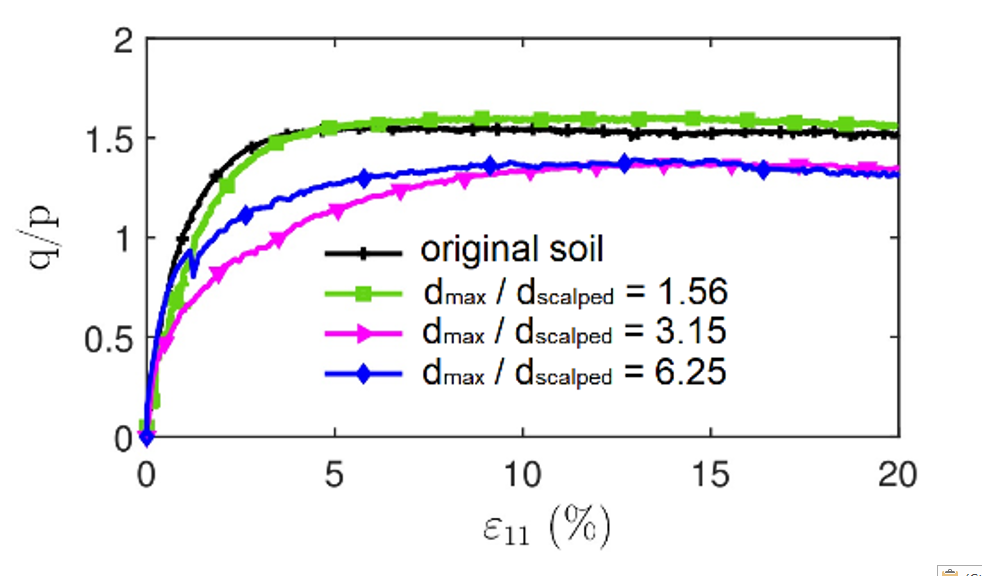


 Experimental and numerical study of the evolution of the permeability of granular soils in the context of internal erosion by suffusion.
 Developed in partnership with IMS RN, this erodimeter can test undisturbed samples under horizontal, oblique or downward vertical flow. An international patent application has been filed for this device.
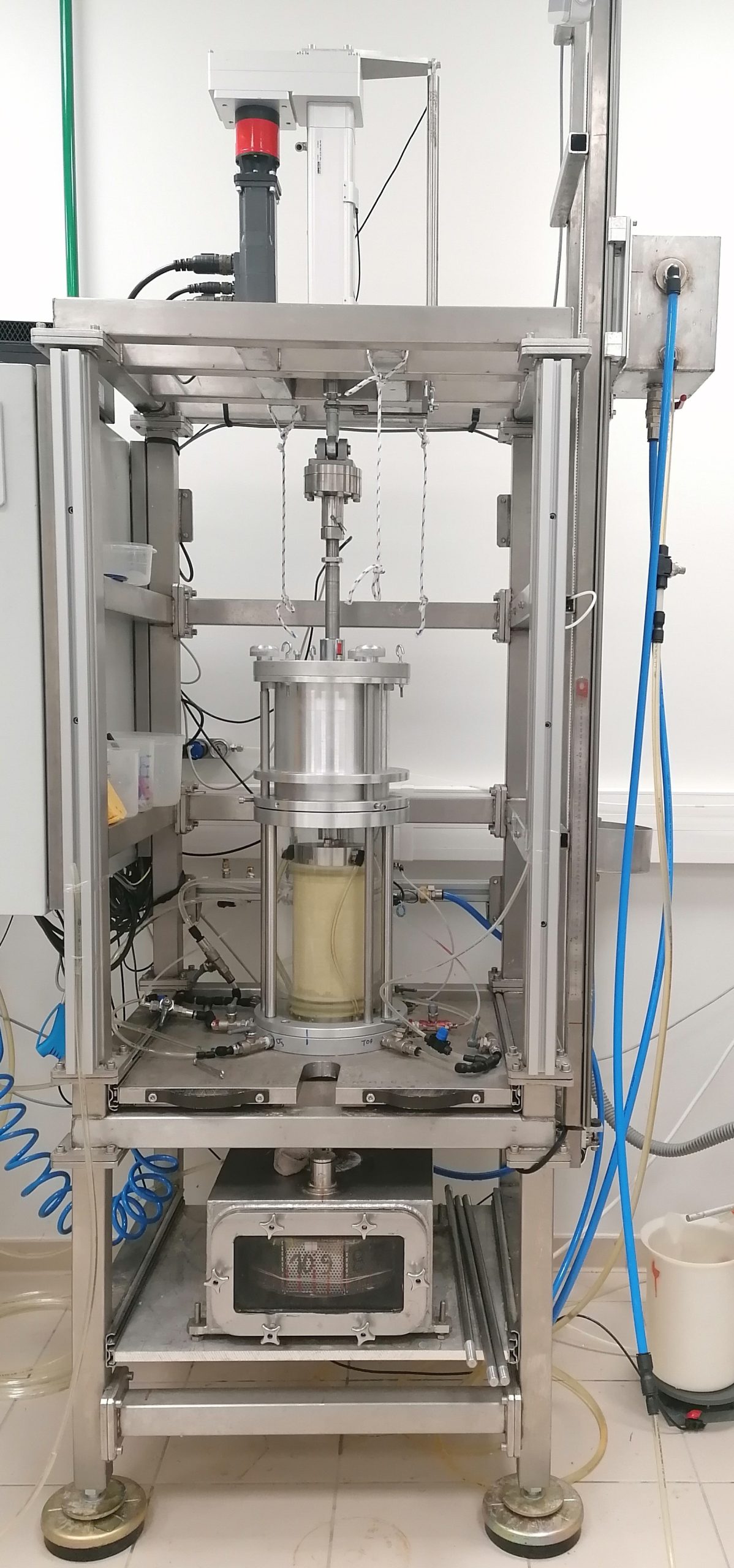
 Developed in partnership with EDF, this erodimeter characterises the hydromechanical behaviour of soil samples with a maximum grain diameter of 16 mm under complex hydraulic and mechanical loading.