Image-based Characterisation of extreme dynamic solid-state flows
This research project, funded by the French National Research Agency (ANR), is a Young Researcher project (JCJC) led by Rian Seghir, CNRS Research Scientist, in collaboration with Professors Thomas Heuzé (ENIB, Brest) and Guillaume Racineux, and research engineer Xiadong Liu at GeM, Centrale Nantes.
The project focuses on characterising extreme plastic flows in metallic polycrystals subjected to very high-velocity impact loading (see Figure 1).
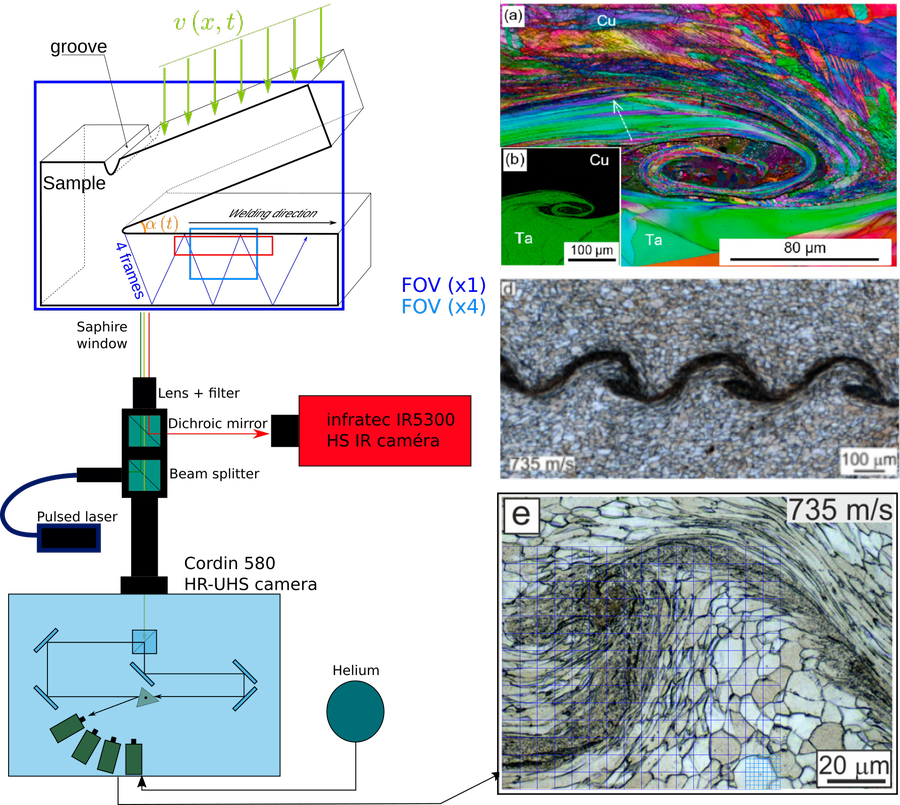
Figure 1: Original experimental design concept for studying, through ultra-high-speed full-field measurements, the mechanical response and wave/structure/microstructure interactions during very high-velocity oblique impacts generated by high pulsed power. Insets a-b-d and e are taken from the following works [1,2] for illustrative purposes.
In metals with a fine microstructure, superplasticity manifests itself as a remarkable elongation at failure (>400%). This type of extreme plastic flow can be highly beneficial for forming applications, but it can also be catastrophic if the presence of defects, combined with superplasticity mechanisms, triggers the onset of plastic instabilities. When metals are deformed at very high strain rates, e.g. during impacts or dynamic processes such as magnetic pulse welding or forming, strong thermomechanical coupling induces dynamic reconfigurations of the microstructure (refinement/growth), which in turn promote, in a non-monotonic way, the emergence or suppression of this type of flow. There is currently no scientific consensus on the mechanisms actually at work at the grain scale, their sequence, or the exact role of temperature.
The project therefore aims to develop an innovative full-field characterisation technique capable of probing, through imaging alone, all the thermomechanical fields and the evolution of the microstructure under severe dynamic loading. To this end, we will develop two unique tools: 1) digital image correlation in high-resolution, ultra-high-speed microscopy, to capture material deformation with spatio-temporal resolutions of around 10 µm and 250 ns. This is made possible by our recent developments in high-resolution, ultra-high-speed quantitative imaging [3,4]. 2) We will then develop a dynamic variant of the so-called Data-Driven inverse method [5] to identify local stress tensor fields from acceleration measurements and conservation laws. The expected results will help us develop more robust physical models in order, for example, to better simulate and develop innovative forming and joining processes that combine high speed with low energy consumption, and to better predict the onset of dynamic plastic instabilities, and hence structural failure.
Project members:
- GeM – Centrale Nantes :
- Rian SEGHIR
- Guillaume Racineux
- Xiadong Liu
- ENIB
- Thomas Heuzé
Dates :
1 January 2024 to 31 December 2027
[1] Paul, H., Chulist, R., Miszczyk, M. M., & Prażmowski, M. (2020). Gradient microstructure in the bonding zone of explosively welded sheets. Procedia Manufacturing, 50, 689-695.
[2] Bataev, I. A., Tanaka, S., Zhou, Q., Lazurenko, D. V., Junior, A. J., Bataev, A. A., … & Chen, P. W. (2019). Towards better understanding of explosive welding by combination of numerical simulation and experimental study. Materials & Design, 169, 107649.
[3] Vinel, A., Seghir, R., Berthe, J., Portemont, G., & Réthoré, J. (2021). Metrological assessment of multi‐sensor camera technology for spatially‐resolved ultra‐high‐speed imaging of transient high strain‐rate deformation processes. Strain, 57(4), e12381.
[4] Eid, E., Seghir, R., & Réthoré, J. (2023). Crack branching at low tip speeds: spilling the T. Journal of Theoretical, Computational and Applied Mechanics.
[5] Vinel, A., Seghir, R., Berthe, J., Portemont, G., & Réthoré, J. (2024). Experimental characterization of material strain-rate dependence based on full-field Data-Driven Identification. International Journal of Impact Engineering, 194, 105083.