


ERC “MASSTICK”
Cracks: when inertia changes everything
Backed by an ERC Advanced Grant, Julien Réthoré is launching the MASSTICK project. His goal: to rethink our understanding of material failure by exploring an avenue that remains largely overlooked, namely the role of inertia in crack propagation.
Funding reserved for the boldest projects
Awarded by the European Research Council (ERC), the Advanced Grant recognizes established, internationally renowned scientists. It gives them the resources to pursue high-risk research with strong potential for scientific breakthroughs.
The selection process is particularly demanding. In 2025, only 319 projects were selected out of 3,329 applications, with total funding of €838 million under the Horizon Europe programme. Each grantee can receive up to €2.5 million for a five-year project.
Why does a crack propagate?
Most material failures begin with a crack. In a brittle material such as glass or certain polymers, this crack can advance at lightning speed until the part fails completely.
The phenomenon has been studied for a long time. Yet current models still cannot explain all the behaviours observed in the laboratory.
This is the grey area MASSTICK aims to shed light on. The project rests on a bold hypothesis: the motion of a crack tip may be partly governed by inertial effects, which classical theories of dynamic fracture still take very little into account.
Observe, measure, model
To put this hypothesis to the test, the team will rely on novel experiments combining state-of-the-art multiphysics instrumentation and ultra-high-speed imaging. These setups will make it possible to track crack growth with exceptional precision and to measure the physical phenomena that accompany it.
The researchers will pay particular attention to what happens at very small scales, as close as possible to the crack tip, where the propagation mechanisms play out. Their observations will then be compared with numerical simulations.
Ultimately, the project has three objectives:
- to propose a new formulation of dynamic fracture;
- to integrate it into numerical simulation tools;
- to build a database of ultra-high-speed imaging and full-field measurements, open to the entire scientific community.
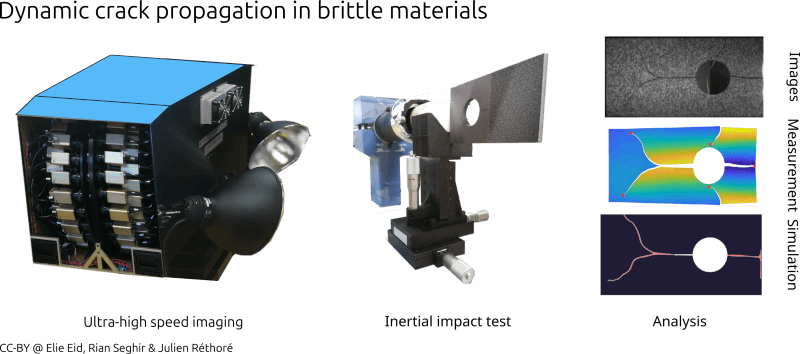
Impact test on a Plexiglas plate. A high-resolution camera (8 megapixels) capable of recording up to 4 million frames per second films the crack as it propagates at several thousand km/h. These images are used to measure displacements within the material and then to build models capable of simulating dynamic fracture.