


For sustainable construction.
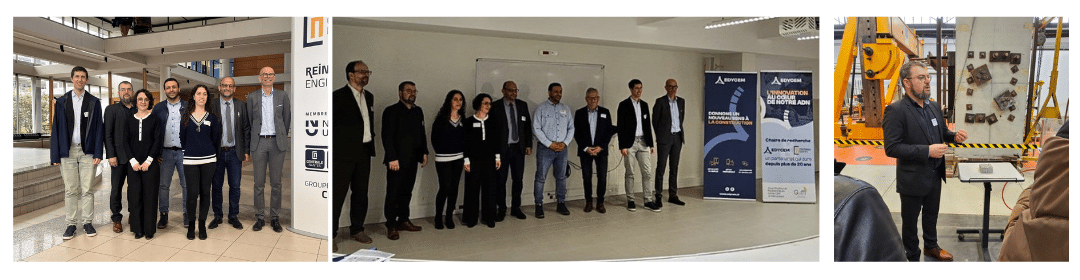
Presentation of the chair’s focus areas by Olivier Collin (CEO, EDYCEM), Daniel Robin (HERIGE), Jean-Baptiste Avrillier (Director, Centrale Nantes), Ahmed Loukili (Professor at GeM, Centrale Nantes, and chairholder), Walid Chebbi (Technical & Innovation Director, EDYCEM), Emmanuel Rozière (Professor, GeM-Centrale Nantes), Sonia Boudache (Research Engineer, GeM-Centrale Nantes), and Frédéric Grondin (Professor, GeM-Centrale Nantes).
After more than 20 years of collaboration, EDYCEM and Centrale Nantes were pleased to welcome the press on March 15, 2024, at Centrale Nantes to present the main focus areas of the research chair led at GeM by Ahmed Loukili.
3 main research themes
Reducing the environmental footprint in concrete design
EDYCEM and Centrale Nantes are exploring ways to reduce clinker content even further while still achieving satisfactory early-age properties. They will study workability by monitoring rheology and how it is maintained over time, as well as mechanical strength during the first hours of the concrete’s life, to ensure rapid formwork removal, even in winter. Shrinkage and cracking sensitivity, which involve viscoelastic properties, will also need to be controlled. EDYCEM aims to use the data collected in this study to promote the use of low-carbon binders within national standardization bodies.
Beyond traditional cements, the work will also explore alternative binders, such as biomass ash, crystallized slag, clays, and fines from crushed concrete, in order to compare performance across a wide range of alternative binders.
Another area the future Research Chair will focus on: testing the incorporation of high rates of recycled aggregates to reduce reliance on marine or alluvial sands, further lowering the environmental impact of concrete.
How Artificial Intelligence (AI) can support next-generation concrete
While concrete made with Portland cement has been widely known and recognized by specialists for over a century, the timescale for exploring new generations of concrete containing less clinker and more supplementary materials will be much shorter, as the climate emergency is driving their adoption. This is a major challenge that requires gathering as much data as possible and analyzing it quickly in order to predict the mechanical behavior and durability of these new materials.
Combining computer simulation with practical testing in the laboratory and at concrete batching plants, this work aims to develop new low-impact concretes while taking into account their physicochemical evolution throughout the service life of the structure. Structural aspects will also feature among the exploratory topics, with the development of eco-design methods for a more rational use of concrete and steel.
Contributing to the challenges of tomorrow’s cities
Cities were extensively sealed with impermeable surfaces at a time when public health was the top priority; it is now necessary to restore a proper balance. The development of housing and infrastructure alters the rate at which water filters into the ground, with an associated flood risk, and also contributes to the formation of urban heat islands (UHI) through radiative trapping (multiple reflections and solar absorption) and restricted airflow in urban canyons.
EDYCEM and Centrale Nantes will work on controlling these phenomena by studying road pavement surfaces.