


 Liste of equipement
The geomechanics platform is equipped with several machines for characterising geomaterials as well as analogue materials. The simple shear and pure shear devices are used to study the shear behaviour of soils.
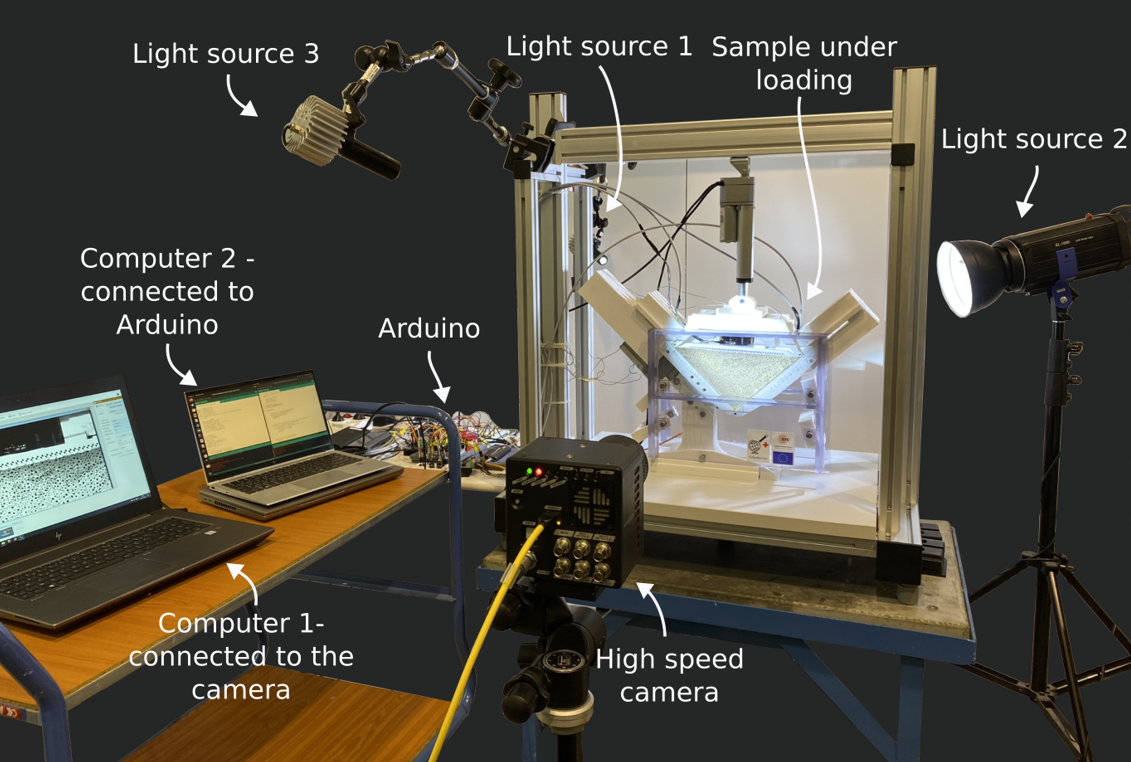
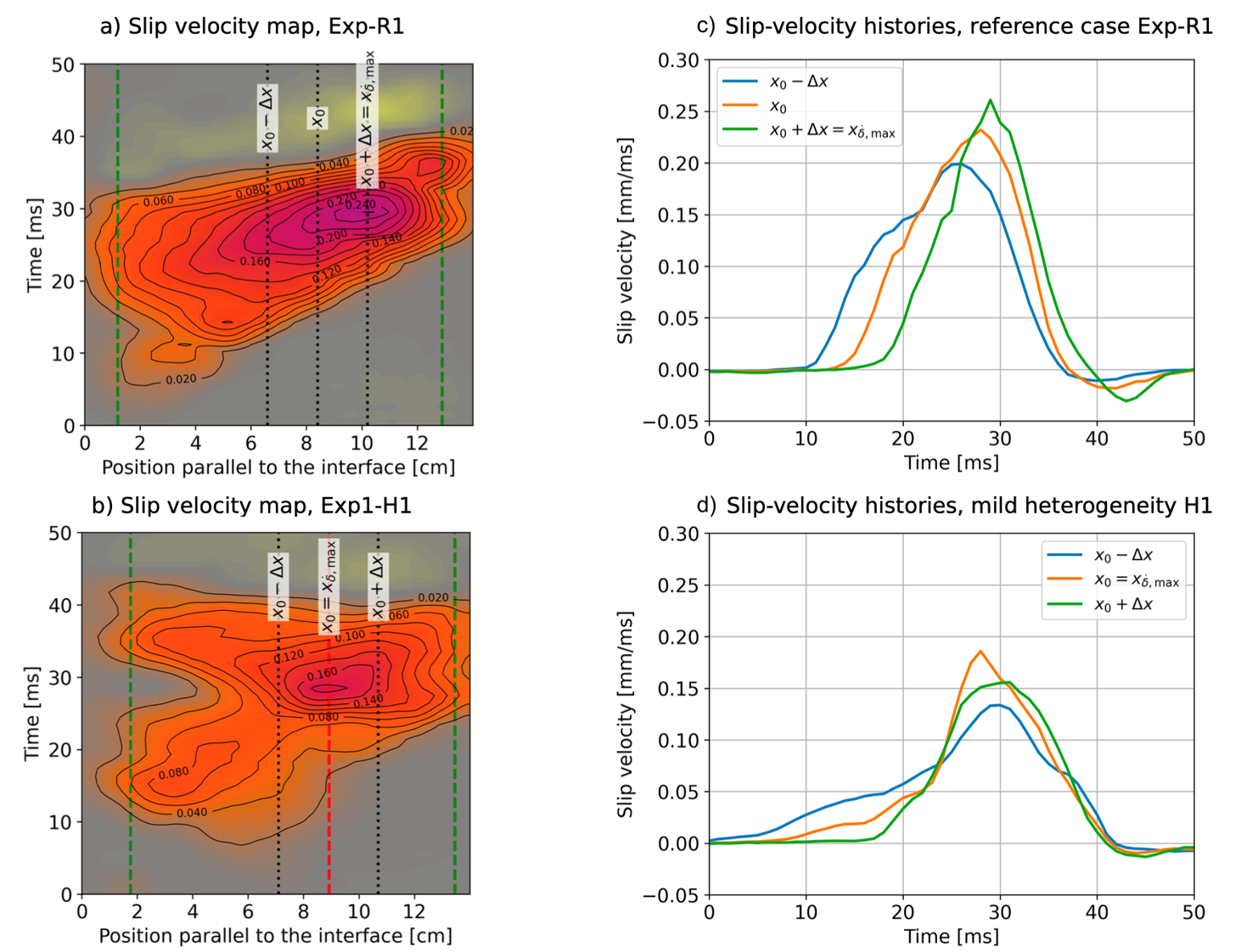
The experimental earthquake simulation setup makes it possible to reproduce seismic-type events in the laboratory at a scale of a few tens of millimetres. It comprises a 3D-printed specimen holder capable of applying a controlled displacement, a triangular specimen made of a paraffin oil-based gel, and a digital camera that records image sequences during dynamic rupture propagation. The specimen interface can be homogeneous or heterogeneous, allowing the study of dynamic rupture propagation.
 |
Hydromechanical instabilities in geomaterials in the context of underground fluid storageThe coupling between two-phase flow and the mechanical response of a granular medium is studied at laboratory scale in order to highlight the interactions between the fingering phenomenon occurring during fluid flow and localised deformation within the granular medium. The proposed experimental campaign makes it possible to perform drainage flows under mechanical stress. While many experimental studies have focused on the morphology of two-phase flow in a Hele-Shaw cell or a 3D medium, full-field quantification of fluid-induced skeleton deformation under hydromechanical loading is still lacking. The aim of the research carried out within the ANR STOWENG project (underground STOrage of reneWable ENergies in low permeability Geomaterials) was, on the one hand, to identify the relationship between the unstable gas flow observed during drainage and localised deformation, using digital image correlation coupled with interface detection, and on the other hand, to highlight the influence of mechanical loading on the level of deformation and the characteristics of the interface. 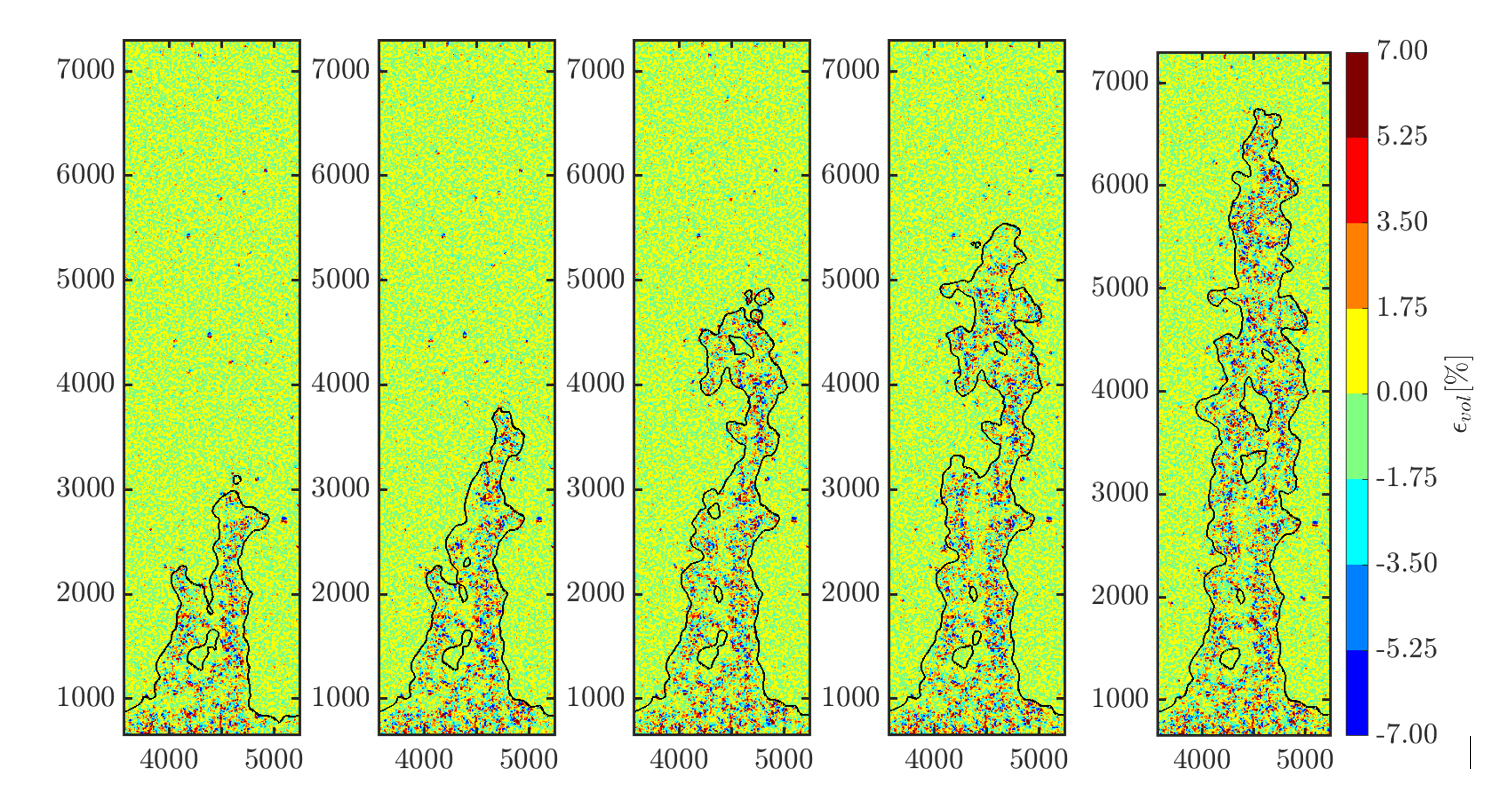
Volumetric strain maps for the right finger detected during drainage. The black lines represent the interface detected using the phase-field method for d = 0.25.
|
Blast ProjectReduced-scale explosion simulator Nevertheless, reduced-scale experiments offer an alternative approach with greater flexibility. In this context, this device opens up new opportunities by allowing us to carry out experiments specifically designed to study the dynamic behaviour of structures subjected to blast loading. For the first time, it enables us to explore and draw valuable conclusions from reduced-scale experiments that faithfully simulate explosion scenarios. |